
The Principles Behind the Craft
Values are not words we put on a page. They are the principles that remain when nobody is watching. They guide how we choose our materials, how we work with artisans, how we design, how we speak about Moroccan heritage, how we treat our customers, and how we decide what BrassNoor should — and should not — become. For BrassNoor, these values come from somewhere deeper than business. They come from craftsmanship. From family. From Morocco. From the Maâlems who taught us through their hands. And from the understanding that traditional craftsmanship is not simply a way of producing objects. It is a way of carrying culture.
1. Authenticity Comes First
For us, authenticity is not simply putting the word “Moroccan” on a product. Authenticity means remaining connected to the roots of the craft while allowing it to evolve naturally. An authentic piece should carry something of the tradition from which it came. Its material. Its construction. Its patterns. Its proportions. Its techniques. Its spirit. Innovation is welcome. Change is necessary. But there are boundaries. When those boundaries disappear, the object may still be beautiful, but it becomes something different. That distinction matters to us. We believe Moroccan craftsmanship deserves to be recognized for what it actually is — not diluted into a generic decorative style simply because the word “Moroccan” makes something easier to sell.
2. Heritage Before Trends
Trends come and go. Heritage remains. We do not want BrassNoor to chase every new style simply because it is fashionable. Our inspiration comes from something much deeper: Moroccan architecture. Traditional craftsmanship. Geometry. Vegetal forms. Light and shadow. The workshop. The medina. The riad. Family memories. The knowledge of the Maâlem. These are not temporary trends. They are part of the cultural language from which our work grows. We can reinterpret them. We can simplify them. We can combine them with contemporary design. But we should never forget where they came from.
3. Handmade Means Human
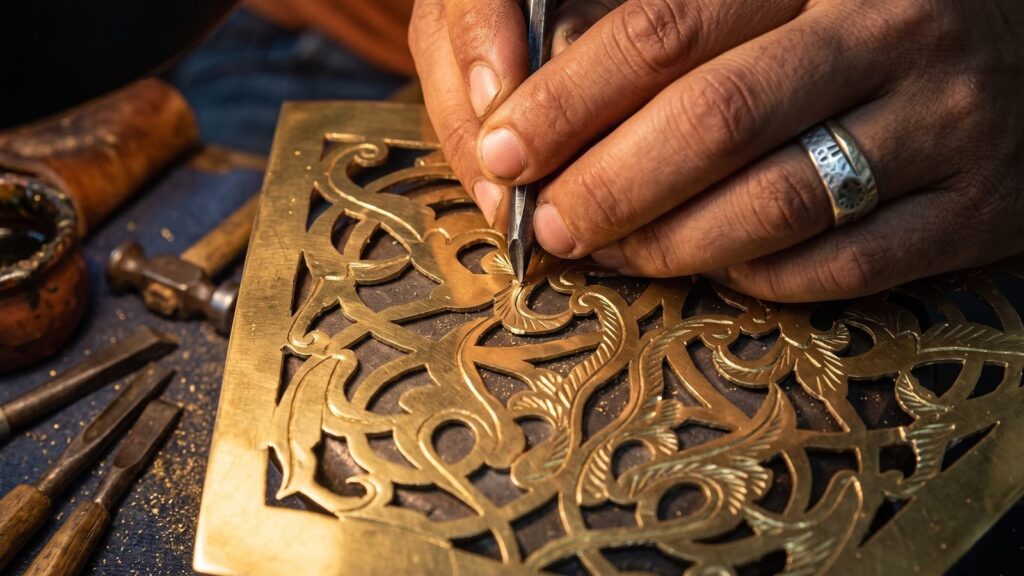
When we speak about traditional handmade craftsmanship, we mean something very specific. The majority of the work is performed by hand using techniques that have been practiced and refined over generations. A piece begins with the material. The sheet is selected according to the design, dimensions, and structural requirements. The pattern is prepared. The sheet is cut according to the required measurements. The traditional piercing and decorative work begins. Engraving adds another layer of detail. Then come assembly, finishing, polishing, and the many smaller stages that are often invisible once the piece is completed. Each stage contains knowledge. Each stage requires experience. And each stage contributes to the final character of the piece. Machines can make some operations faster. But speed is not the definition of traditional craftsmanship. For us, the human hand must remain at the heart of the process.
4. The Soul Cannot Be Mass-Produced
There is a temptation in modern production to measure success through speed. More pieces. Less time. Lower cost. Greater volume. But traditional craftsmanship follows a different logic. Its value comes partly from the time invested in it. The attention. The repetition. The experience. The decisions made by the artisan. The small variations created by the human hand. The knowledge accumulated over years. Traditional craftsmanship is, at its heart, spirit and culture — not simply the production of objects and the supply of products. We cannot turn to industrial production simply to make things faster if doing so causes us to lose the spirit of creativity and the essence of traditional craftsmanship. A handmade object should not become an industrial product simply because industrial production is more efficient. Efficiency has its place. But it should never be allowed to erase the soul of the craft.
5. The Value of Art Is Greater Than Its Price
A handmade object cannot always be measured by its selling price. A Maâlem may spend hours, days, or weeks creating a piece and eventually sell it for a price that reflects only what he needs to support his life at that moment. But the value contained within that piece can be much greater. It contains his knowledge. His experience. His time. His creativity. His patience. His mistakes. His improvement. His memory. His hands. And, in a sense, a part of his life. This is true of art everywhere. A painting can be sold for millions even though the canvas and paint themselves cost very little. The price does not measure the material. It reflects the human value of the creation. We believe handmade Moroccan craftsmanship deserves the same understanding. A BrassNoor piece is therefore not simply brass, wire, sockets, and a shade. It represents human time transformed into an object.
6. The Maâlem Is a Custodian of Knowledge
A Maâlem is, first of all, a skilled craftsman. But the title represents more than technical ability. The Maâlem’s knowledge is built through experience. Many begin their journey as young workshop apprentices, learning through observation, repetition, service, correction, and practice. They gradually become familiar with every stage of production. They learn how to prepare materials. How to measure. How to cut. How to draw. How to model. How to pierce. How to engrave. How to assemble. How to finish. And eventually, how to teach. But beyond technical knowledge, many Maâlems carry another kind of knowledge. The knowledge that comes from a lifetime of simple work, human relationships, patience, and observation. In our experience, many of the Maâlems we have known are artists by nature. They love their craft. They enjoy simplicity. They possess enormous practical knowledge. And their understanding of life often extends far beyond the workshop. That deserves respect.
7. The Artisan Must Be Seen
The artisan should never disappear behind the product. When someone looks at a BrassNoor piece, we want them eventually to wonder: Who made this? What hands shaped it? Who pierced these patterns? Who spent hours creating these details? What knowledge made this possible? We believe artisans deserve recognition for their contribution. They deserve dignity. They deserve respect. They deserve to be recognized as artists and custodians of a tradition. The person who creates the object is part of its story.
8. Family Heritage Is Our Foundation
Without our family heritage, there is no BrassNoor. Our connection to craftsmanship did not begin with the creation of a website or a brand. It existed before the name BrassNoor. It existed in our homes. In our family. In the hands of previous generations. In the crafts that surrounded us. In the memories we inherited. This heritage feeds our imagination. It influences how we see materials. How we understand patterns. How we think about craftsmanship. How we judge quality. And how we understand the relationship between an object and the person who made it. BrassNoor is not separate from this heritage. It grows from it.
9. Innovation Must Have Roots
We believe tradition and innovation can exist together. But innovation without roots can quickly become imitation of something else. We want to create new designs. We want to experiment with proportions. We want to develop new collections. We want Moroccan craftsmanship to live naturally inside contemporary architecture and interiors. But our innovation must remain connected to the visual and cultural language that inspires us. For us, there is a difference between: evolving a tradition and abandoning it. That difference must remain clear.
10. There Are Boundaries
Authenticity requires boundaries. Our work is guided by principles inherited from our cultural and artistic context. The traditional visual language that informs our work is primarily built around geometric and vegetal forms. These principles are not limitations on creativity. They are part of the identity from which creativity grows. A design can be contemporary while still carrying recognizable Moroccan character. But when the essential visual language disappears completely, calling the result traditional Moroccan craftsmanship becomes misleading. For example, a modern industrial-style copper lamp may be beautiful and may even be produced in Morocco. But if its construction and visual language have abandoned the characteristics of traditional Moroccan craft, we should describe it honestly as contemporary Moroccan design — not pretend that it is traditional craftsmanship. Honesty in classification matters.
11. Quality Begins Before the Craftsmanship
Quality begins with the material. The choice of metal matters. Its type. Its thickness. Its characteristics. Its suitability for the dimensions and structure of the piece. Larger pieces require appropriate material thickness. Every technical decision affects the final result. The material is the foundation. Then craftsmanship builds upon it. And finally, finishing reveals it. Quality therefore does not belong to one stage. It runs through the entire journey. From the sheet of metal to the finished piece. From construction to presentation. From packaging to delivery.
12. Detail Is a Form of Respect
Traditional Moroccan craftsmanship can be extraordinarily detailed. For us, detail is not decoration for decoration’s sake. It is discipline. It is patience. It is the difference between something that simply fills a space and something that rewards careful observation. The work of the artisan can sometimes resemble the work of a jeweler. Every small decision matters. Every line. Every opening. Every joint. Every finish. Every transition. The closer you look, the more you should discover.
13. Handmade Beauty Is Found in Imperfection
The beauty of handmade craftsmanship comes partly from its refusal to become perfectly mechanical. Two handmade pieces can share the same design without being identical. A line may vary slightly. A pattern may carry a tiny difference. A handmade joint may reveal the movement of the artisan’s hand. These variations are not necessarily defects. They are evidence that a human being made the object. The secret of handmade beauty is its imperfection. We do not want to remove every trace of the hand in pursuit of industrial uniformity. We want the hand to remain visible.
14. We Will Not Borrow What We Do Not Understand
One of the problems facing traditional crafts today is the circulation of designs without their history. Patterns are copied. Names are borrowed. Styles are mixed. Industrial products are presented as handmade. Objects made far from Morocco are sometimes marketed as authentic Moroccan craftsmanship. This creates confusion. It makes it difficult for customers to understand what they are actually buying. It also risks reducing centuries of craftsmanship to a superficial visual style. Our response is not simply to criticize. It is to document. To learn. To explain. To create a body of knowledge that allows people to understand the differences between traditions. Moroccan. Egyptian. Turkish. Indian. Chinese industrial production. And the many other artistic languages that exist around the world. Each has its own history. Our responsibility is to understand and represent ours honestly.
15. Documentation Is Part of Preservation
We believe that knowledge that is not documented can eventually be misunderstood, diluted, or lost. That is why BrassNoor will not only document its products. We want to document the knowledge behind them. Patterns. Shapes. Techniques. Terminology. Materials. Regional characteristics. Architectural influences. Family stories. Maâlem knowledge. Design inspiration. The evolution of our own work. Over time, this can become a living archive. Not a museum of objects that can no longer change. But an archive of knowledge that continues to grow.
16. We Owe the Customer More Than a Product
When someone chooses a BrassNoor piece, we believe we owe that person something. Not only a functioning light. Not only beautiful craftsmanship. Not only careful packaging. We owe them honesty. We owe them authenticity. We owe them the story behind the object. When someone buys from BrassNoor, they should receive more than a decorative object. They should receive a piece of history. A piece of Moroccan cultural heritage. A piece of craftsmanship. And, as our family expresses it: a piece of our soul. Because hours of human life were invested in creating that object.
17. Craftsmanship Before Profit
Profit is necessary for a business to survive. But profit cannot become the reason craftsmanship loses its identity. If increasing production requires us to remove the human element that gives the work its meaning, then we must question whether that increase is actually progress. We would rather grow carefully than grow by destroying the very thing that made BrassNoor worth building. The business must serve the craft. The craft must never be sacrificed simply to serve the business.
18. We Respect the Past by Creating the Future
Respecting heritage does not mean living in the past. Our responsibility is not to freeze Moroccan craftsmanship in one historical moment. It is to carry its spirit forward. We want to create designs that could not have existed exactly as they do today while still feeling connected to the tradition that inspired them. We want future generations to look at BrassNoor and recognize both: where it came from and where it helped Moroccan craftsmanship go.
19. Truth Before Marketing
We will never create a beautiful story at the expense of truth. If the historical origin of a pattern is documented, we will explain it. If a story belongs to our family tradition, we will identify it as such. If an origin is uncertain, we will say that it is uncertain. If a piece is contemporary rather than traditional, we will describe it honestly. We believe authenticity is more valuable than a perfect marketing story. The truth may sometimes be less dramatic. But it will always be more meaningful.
20. The BrassNoor Principle
All of these values come together in one principle: We do not simply make objects. We carry knowledge forward. Every piece begins with material. Then comes the hand. Then experience. Then creativity. Then light. And finally, the object enters another person’s life. The journey does not end when the piece leaves our workshop. It continues in the home where it hangs. In the shadows it creates. In the conversations it starts. In the person who asks where it came from. And perhaps, one day, in another generation that discovers the craft because someone chose to preserve it. That is what we value. That is what we protect. That is what BrassNoor stands for.
The Art of Moroccan Brass Lighting.
Bring the craft home — explore our handmade Moroccan lighting.