
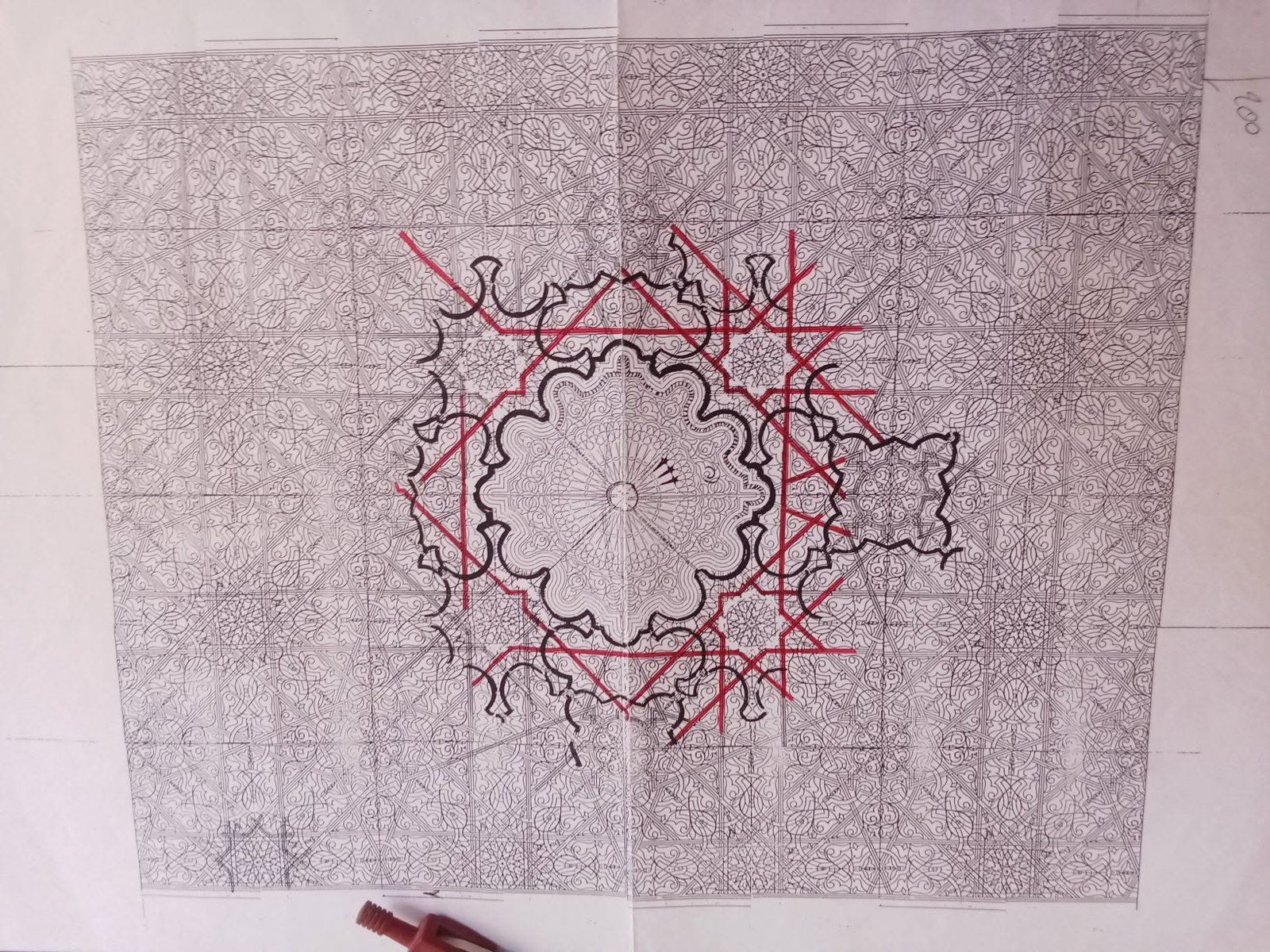
Moroccan ornament is often seen from the outside as decoration. But for those who know the craft from within, it is much more than decoration. It is a language. It has its own vocabulary, its own rules, its own mathematics, its own rhythm, and its own memory. It has been carried from one Maâlem to another, from one generation to the next, sometimes without books, without written instructions, and often without the modern instruments we take for granted today. To understand a Moroccan brass lamp, therefore, is not simply to understand its shape. It is to begin reading the language inside it.
7.1 The Pattern Begins With an Idea
Before there is a finished lamp, there is an idea. The Maâlem first considers the piece itself: its shape, its dimensions, its purpose, and the space where it will eventually live. A pendant intended for a high ceiling is not necessarily treated like a small lamp for a corner. A large surface gives a pattern room to breathe. A smaller surface may require a simpler rhythm. The pattern must belong to the object. This is one of the first principles of the craft: the ornament cannot be separated from the form. The Maâlem does not simply ask, “Which pattern is beautiful?” He asks: Which pattern belongs here?
7.2 The Circle, the Division and the Geometry
Much of Moroccan geometric ornament begins from simple geometric principles. The circle, the square, the line, the axis and their divisions can become the foundations from which much more complex compositions emerge. What appears complicated to the eye may have begun with something extremely simple. A circle can be divided. The divisions can be connected. Lines can intersect. Shapes can repeat. A central star can become surrounded by other forms. One unit can connect to another until an entire field of ornament appears. This is the world of tastir: the geometric construction and organization behind the ornament. For the experienced Maâlem, these operations eventually become deeply internalized. After decades of practice, sometimes thirty, forty or fifty years, his eye can often estimate what needs to happen simply by looking. But experience does not eliminate mathematics. When precision is required, calculation remains essential. The eye may know approximately where to go. The calculation tells the hand exactly where to go.
7.3 The Names Carry the Geometry
The names of Moroccan geometric patterns are not arbitrary. Many are connected to the geometry of the composition, particularly the central star and the number of its points. Eight, ten, sixteen, twenty, thirty-two and other divisions can generate different visual structures and different families of ornament. A pattern can therefore carry its geometry inside its name. Among the more complex forms is what craftsmen may refer to as Mkhabel l3qoul — literally evoking something that can “confuse the mind.” It can be found across different Moroccan crafts, including brass, wood, plaster and zellij. Its complexity is not simply visual complexity. It is structural complexity. The eye sees an extraordinary composition, but behind that composition are divisions, proportions, intersections, repetitions and relationships that must work together. This is why a person unfamiliar with the craft may look at it and simply see beauty, while a Maâlem sees the construction hidden underneath. Every ornament can have its own history, its own name, its own method of construction and its own place within the vocabulary of Moroccan craftsmanship.
7.4 One Language, Many Crafts
Moroccan ornament does not belong to one material. The same visual language can travel between crafts. A pattern may appear in copper, wood, plaster, zellij, ceramics or even textiles, while changing slightly according to the material and the person executing it. Sometimes the same pattern may have different names depending on the craft. Sometimes the same name may be accompanied by another expression that describes its particular use. This is one of the beautiful characteristics of Moroccan craftsmanship: the crafts are not isolated worlds. They speak to each other. A form understood by one Maâlem may be recognized by another working in a completely different material. The vocabulary changes slightly. The principles remain recognizable. This creates a kind of cultural conversation between the crafts.
7.5 Tawriq: More Than One Meaning
The word tawriq itself carries more than one meaning within the world of the craft. One meaning relates to the treatment and preparation of copper: working the metal so that its thickness and character become appropriate for the object being made. There are also older memories of working copper before modern rolling machinery was available. According to stories passed down through the family, sheets could be worked through repeated hammering and forging until the desired character and thickness were achieved. Another meaning of tawriq refers to vegetal ornament: leaves, stems and plant-inspired forms engraved or expressed on copper. This second meaning connects brass craft to the broader Moroccan vocabulary of vegetal decoration. The same visual idea can appear in plaster, wood, textiles and other crafts, adapted to the material in which it is created. So even a single word can carry several layers of craft knowledge.
7.6 The Maâlem’s Memory
For generations, much of this knowledge did not depend on books. Many Maâlems were not formally educated in reading and writing, yet they developed sophisticated knowledge through years of observation, practice, measurement and repetition. They learned geometry through their hands. They learned proportions through their eyes. They learned patterns through memory. A young apprentice could enter a workshop and begin learning from the smallest tasks. Slowly, through years of observation and practice, he could progress through the different stages of the craft until he eventually became a Maâlem himself. The knowledge was not simply: “Here is a picture. Copy it.” It was: “Understand how it works.” That distinction is fundamental. A Maâlem who understands the principles can reproduce an existing pattern, adapt it to a new surface, solve a problem, or sometimes create something that did not exist before.
7.7 From Maâlem to Maâlem
Patterns and techniques were traditionally transmitted from teacher to apprentice. The apprentice learned from the Maâlem, eventually becoming a Maâlem himself, and then teaching another generation. In this way, the craft became a chain of knowledge. One generation received something. It preserved it. It sometimes changed it. It sometimes created something new from it. Then it passed it forward. This is one reason traditional craftsmanship can survive for generations without being frozen in exactly the same visual form. The foundations remain. The human hand continues to interpret them. But this chain is becoming increasingly fragile. Globalization and economic conditions have made it more difficult for younger generations to dedicate themselves to traditional crafts. When a young person chooses another path, it is not only a pair of hands that disappears from the workshop. A part of a knowledge system may disappear with it. This is one of the reasons BrassNoor exists. Not to claim ownership of this heritage, but to help preserve, document and transmit some of the knowledge received from those who came before us.
7.8 The Spirit of Open Knowledge
There is another important characteristic of traditional craftsmanship: knowledge was not necessarily created to be monopolized. A Maâlem could create a new composition and allow other craftsmen to use it. Stories of craftsmen creating new patterns and making them available to others illustrate something important about the spirit of the craft: creation could become part of the collective heritage. The pattern could travel. Another Maâlem could use it. Another could adapt it. Another generation could learn from it. In this sense, traditional craftsmanship behaves less like a private collection of isolated inventions and more like a living cultural language.
7.9 From the Drawing to the Brass Sheet
Once the pattern and the object have been chosen, the ornament has to leave the world of the drawing and enter the material. This is where another major part of the Maâlem’s knowledge begins. A finished brass lamp may appear to be one object. In reality, it can be made from many individual pieces. The Maâlem must understand the dimensions and shape of every piece before assembly. He must know where each piece belongs. He must know how the ornament will continue from one piece to the next. If two pieces are joined together, the pattern must meet correctly. There cannot be a sudden displacement in the line. There cannot be a star that loses its symmetry at the joint. The pattern must continue as if the separate pieces had always been one surface. This is why measuring, dividing, cutting and assembling are not secondary tasks. They are part of the design itself.
7.10 Cutting Is Part of the Art
One of the stages that is often invisible to the person looking at a finished lamp is the cutting and separation of its individual components. The Maâlem divides the piece into the required parts, applies the pattern according to the dimensions and form, calculates how those parts will meet, and then prepares them for cutting, piercing, engraving and assembly. A mistake at an early stage can become much more serious later. The possibility of correcting a mistake also depends on the material and the stage of production. A drawing can be erased. A piece of wood that has been cut incorrectly may need to be replaced. A damaged or incorrectly pierced brass component may be difficult or impossible to recover without remaking it. This is why experience matters so much. The Maâlem is not only thinking about the piece in front of him. He is already thinking about the piece that will exist after it has been cut, assembled and finished.
7.11 Flat Sheet to Three-Dimensional Form
In many brass lamps, the ornament begins on a flat sheet. The pattern may be transferred to the sheet. The openings are marked. The Maâlem performs the piercing or cutting. The pieces are then formed and assembled into the desired three-dimensional object. The same pattern therefore has to survive a transformation: drawing → flat metal → individual pieces → assembled form → finished lamp. At every stage, the relationship between the parts must remain coherent. The material itself also changes the way the pattern behaves. A pattern expressed in plaster may have depth and volume. Wood can produce another type of relief. Zellij has its own logic as a composed surface. Copper and brass have their own qualities, thicknesses and methods of piercing and engraving. The pattern may be recognizable across materials, but it can never behave exactly the same way in every material.
7.12 Not Every Pattern Belongs on Every Piece
There is no universal rule that every Moroccan pattern can be placed on every object. The pattern has to respect the dimensions and geometry of the piece. A complex composition needs enough space to breathe. If a very complicated pattern is compressed onto a small surface, the relationships between its elements can become crowded and difficult to read. The shape of the lamp matters as well. A flat sheet, a cylinder, a dome and a sphere do not offer the same geometric conditions. The Maâlem therefore chooses and adapts the ornament according to the object. This is where craft becomes both art and engineering.
7.13 Piercing Can Become the Design
Piercing, or tkhriem, is not merely a technique for allowing light to escape. It can itself become the ornament. A simple geometric object can be transformed by the arrangement of its openings. The holes can be small or large. They can be geometric or vegetal. They can be dense or open. They can create rhythm even when there is no elaborate engraved pattern around them. When the lamp is switched off, the viewer sees the form of the object, the color of the metal and the beauty of the pierced surface. When the lamp is switched on, the same openings become a different language. Light passes through them. The walls and ceiling receive the pattern. The object has acquired another life.
7.14 Pattern, Light and Shadow
The Maâlem therefore does not necessarily think only about what the pattern looks like on the metal. He must also consider what it will become when illuminated. The density of the piercing, the size of the openings and the surface area of the lamp influence the relationship between light and shadow. A lamp designed for a particular corner, a large room, an outdoor environment, a high ceiling or a lower ceiling may require different considerations. The ornament has a visual life when the lamp is off. It has another life when the lamp is on. This is why the lamp and the light complete each other. The lamp has two lives: the life of the object, and the life of the light.
7.15 “3aynek Mizanek” — The Eye as a Measure
There is a Moroccan saying: “3aynek mizanek.” Your eye is your scale. For an experienced Maâlem, this is not simply a poetic expression. Years of repetition train the eye to recognize proportion, symmetry and imbalance. A person unfamiliar with the craft may look at a finished piece and say: “What a beautiful piece. It is perfectly made.” The Maâlem sees something else. He sees the center. He sees the spacing. He follows the lines. He notices whether a repeated element has shifted. He sees whether the rhythm has been broken. He sees whether two pieces meet correctly. He can feel when something is too tight, too open, too heavy or slightly out of balance. This does not mean the handmade object must be mechanically identical at every point. Quite the opposite. Small variations created by the human hand can become part of its beauty. The important thing is that the variation remains within harmony. The machine seeks uniformity. The Maâlem seeks perfection through the hand.
7.16 The Maâlem’s Eye and the Mathematician’s Eye
The same pattern can therefore be experienced at different levels. The ordinary visitor may simply be amazed. He may stand in front of a piece for a long time without realizing how much time has passed. He sees beauty. But an artist, mathematician or craftsman may see another world inside the same object. He begins to analyze the relationships. He asks: How was the center established? How were the divisions calculated? How do the lines continue? How do the pieces meet? How was the symmetry maintained? What rules allowed this composition to exist? It can feel almost like looking at a complicated mathematical equation whose solution is standing directly in front of you, while the method of reaching that solution remains difficult to understand. The beauty is therefore not only in the answer. It is also in the intelligence hidden inside the answer.
7.17 Moroccan Ornament as a Language
This leads to one of the deepest ways of understanding Moroccan ornament. It can be approached as a language. The basic geometric and vegetal elements become its vocabulary. The combinations of these elements become its expressions. Tastir provides part of its grammar. Proportion, repetition, symmetry and rhythm organize the relationships. A finished composition becomes a visual sentence. A complex architectural composition can become almost like a poem. The Maâlem who truly understands the system is therefore not simply memorizing pictures. He is learning how the language works. And once he understands the language, he can sometimes create new expressions without abandoning the identity of the language itself. That is the difference between copying a pattern and understanding a tradition.
7.18 Creation Without Losing the Roots
For BrassNoor, this distinction is essential. A contemporary Moroccan design can exist. Innovation is not the enemy of tradition. But innovation must still understand its roots. If a contemporary piece carries a genuinely Moroccan pattern and the pattern remains central to its identity, it can be understood as Moroccan contemporary. But if a modern lamp simply receives a small amount of Moroccan decoration, then, from the BrassNoor point of view, it may be more accurate to call it: a modern lamp with Moroccan decoration. The distinction matters because Moroccan identity is not created simply by placing an ornament on an object. It comes from understanding the language behind the ornament.
7.19 When a Maâlem Creates Something New
A Maâlem is not necessarily a copyist. Once he understands the principles deeply enough, he can create. He can begin with an old pattern. He can change its divisions. He can combine elements. He can adapt the composition to a new form. He can solve a new structural problem. He can create something that belongs to the same language without being an exact repetition of something made before. This is why two Maâlems can make the same model and still produce pieces that are not completely identical. Each hand carries its own experience. Each eye sees slightly differently. Each Maâlem has spent his life developing his own relationship with the material.
7.20 What Happens When the Maâlem Is Gone?
Perhaps the most important question is not what happens to the pattern. It is what happens to the knowledge behind it. When a Maâlem dies, the fundamental language of the craft does not necessarily die with him. The basic geometry can remain. The patterns can remain. The techniques can continue. Another Maâlem can teach them. But the particular creations of that person may disappear. The patterns he invented. The combinations he discovered. The solutions he developed. The small decisions that existed only in his memory. The way he understood a difficult shape. The way his eye judged a proportion. The way his hand solved a problem. These can disappear forever. The Maâlem may leave behind the alphabet. But his own poems can disappear. That is what is at risk.
7.21 The BrassNoor Archive
This is where BrassNoor finds one of its deepest purposes. The goal is not to turn Moroccan ornament into a frozen museum object. It is to help preserve the memory of the language. To document names. To document patterns. To document methods. To record the words used by craftsmen. To preserve stories. To understand how a pattern moves between copper, wood, plaster, zellij and other crafts. To remember the people who carried the knowledge. And, when possible, to record not only what a pattern looks like, but how it is constructed and why it exists. Because a photograph of a pattern preserves its appearance. Understanding its construction preserves something much deeper.
7.22 The Last Impression
Imagine a visitor entering a future BrassNoor museum. He sees a Moroccan brass piece. Perhaps he knows nothing about the craft. He simply stops. He looks. He becomes fascinated by its precision. He wonders how human hands could create something so complex. He continues looking. Minutes pass without him noticing. That is one kind of experience. But perhaps another visitor is an artist. Or a mathematician. Or a craftsman. He looks at the same piece and begins trying to decode it. He sees relationships inside relationships. He searches for the logic of its construction. It is almost like standing in front of a difficult mathematical equation and knowing that the solution is there, visible, complete, and beautiful — yet still struggling to understand how someone arrived at it. Both visitors are experiencing the same object. But they are reading different layers of the same language. And beneath both experiences is something even greater: culture. A language. Mathematics. Memory. The intelligence of human hands. The accumulated knowledge of people who lived before us and created extraordinary things with tools and possibilities very different from those available today. That is what Moroccan ornament should leave behind. Not simply admiration. Not simply knowledge. But a feeling. A piece that remains in the mind long after the visitor has walked away. A piece that becomes impossible to forget. Because the ultimate goal is not simply for someone to look at a Moroccan lamp. It is for the lamp to remain inside them. To see it, to wonder at it, to become fascinated by it — and to carry it with them for life. That is when ornament stops being decoration. It becomes memory.
← Previous: The BrassNoor Philosophy | The BrassNoor Bible | Next: The Maâlem: The Man Behind the Craft →