
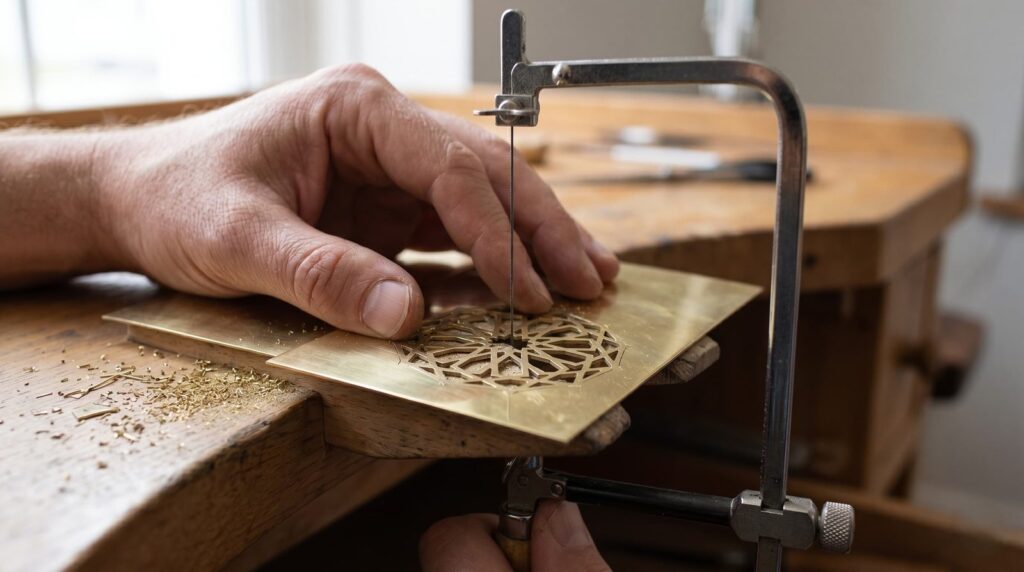
Behind every piece of Moroccan brasswork, there is a person. Before there is a pattern, a sheet of copper, a pierced surface, or a finished lamp, there is the Maâlem — the master craftsman whose hands, eyes, memory, experience, and character give life to the work. To understand Moroccan craft, it is not enough to understand the object. You must understand the man behind it.
8.1 How a Child Enters the Workshop
A young person often enters the workshop for reasons that have little to do with art at first. Sometimes he comes because his family needs him to work and help his parents. Sometimes school was simply not the path that suited his circumstances. That does not mean he is lazy or incapable. Life circumstances can take a young person away from the classroom and toward another kind of education. Sometimes parents themselves decide that their child should learn a craft. There is an old Moroccan wisdom that says: “A skill carried in your own hands can be more valuable than inherited wealth.” And there are also those who do both — they continue their studies while learning a craft. The workshop can therefore become another kind of school. Not a school of books, but a school of observation, patience, discipline, repetition, mistakes, experience, and eventually creation.
8.2 The First Lesson Is Not Always the Craft
When a young apprentice first enters a workshop, he does not immediately sit down and begin making complicated patterns. He is still young. First, he becomes familiar with the world around him. He may help the Maâlem with things that are outside the actual craft: cleaning the workshop, arranging pieces, preparing things, carrying or filling a small tea kettle, helping with simple tasks. These things may appear insignificant. They are not. The apprentice is learning the atmosphere of the workshop. He is learning how people speak to one another. He is watching how the Maâlem works. He is discovering the rhythm of the place and becoming familiar with the people, the tools, the materials, and the discipline of the workshop. Little by little, he is allowed to enter the craft itself. He may begin with simple work such as cleaning and polishing pieces or helping with finishing. Then another task. Then another. Step by step, his hands become familiar with the material. And slowly, almost without noticing it, the apprentice begins to climb the ladder of the craft. Until one day, after years of learning, he is no longer simply the young boy who entered the workshop. He has become a Maâlem himself.
8.3 The Maâlem and the Apprentice
The relationship between Maâlem and apprentice is not simply that of teacher and student. The Maâlem often sees the apprentice almost like a son. And the apprentice can see his Maâlem as a father figure, a guide, and an example. The knowledge is not transmitted only through words. The apprentice watches. He observes how the Maâlem holds a tool. How he looks at a piece. How he approaches a difficult problem. How he corrects an error. How he prepares his work. How he respects the material. And eventually, how he thinks. This is why traditional craft cannot be learned completely from a book. A book can explain. A Maâlem can show. And the apprentice must repeat, fail, observe, correct, and repeat again until knowledge becomes part of his hands.
8.4 Why the Maâlem Can Be Strict
From the outside, the relationship between a Maâlem and his apprentice can sometimes appear severe. The Maâlem can be strict. Sometimes very strict. But there is a reason. Traditional craft is a discipline of precision. It has a rhythm. It is almost like a clock: tick, tick, tick. You cannot simply skip an important step because you are impatient. You cannot ignore a detail because nobody will notice. You cannot treat precision as something optional. The strictness of the Maâlem is therefore not simply punishment. It is training. He is trying to plant precision, discipline, patience, and respect for the work inside the apprentice. Because in traditional craft, one small mistake can affect what comes later. The apprentice must understand that every stage has its place. The craft has its rhythm. And the rhythm must be respected.
8.5 When Does an Apprentice Become a Maâlem?
There is no single number that automatically transforms an apprentice into a Maâlem. Some people can spend ten years in a craft and still say: “I am not a Maâlem.” Others may spend only a few years and already want people to call them one. This is partly a question of personality. But from my own perspective, becoming a true Maâlem requires at least around six years of continuous work in the craft. Six years is not a certificate. It is only the beginning of enough time to experience the craft seriously. Because craft is not something you simply count in years. You drink it through experience. You observe. You make mistakes. You try different styles. You discover different methods. You face problems. You solve them. You repeat the work until your hands begin to understand what your mind is asking them to do. That is how experience becomes knowledge.
8.6 The Maâlem Is Recognized by Others
A person does not become a Maâlem simply because he announces: “I am a Maâlem.” The real recognition comes from others. People who have seen his work begin to recognize something in it. Sometimes they may look at a finished piece and say: “This is the work of a Maâlem.” Even without knowing who made it. Because the word Maâlem carries the meaning of mastery. It is connected to someone who has reached a level of perfection in his work. The title therefore belongs, in the deepest sense, to the quality of the work — and to the experience and character behind it.
8.7 Twenty Years of Experience
Twenty years in a craft is not a small thing. A person who has genuinely spent twenty years working continuously in the craft has necessarily encountered an enormous range of situations. He has made mistakes. He has corrected mistakes. He has worked with different forms. He has encountered different materials, styles, problems, and methods. He has seen what works. He has seen what fails. He has repeated processes thousands of times. And every experience adds something. Craft drinks experience. Twenty years gives the hands thousands of memories and gives the eyes thousands of comparisons. The Maâlem gradually develops something that cannot be taught in one lesson: the instinct of experience. But instinct does not mean abandoning precision. The experienced Maâlem may sometimes know approximately what needs to happen simply by looking. Yet when exactness is required, calculation and precision remain essential. Experience tells him what he is seeing. Knowledge tells him how to solve it. And the hands execute the solution.
8.8 The Maâlem Sees the Whole Piece
One of the greatest differences between a beginner and a Maâlem is not simply the ability to perform a task. It is the ability to see what the task will become. A finished brass piece may be made from many separate components. The Maâlem must understand each component, its dimensions, its shape, the pattern that will be placed on it, and how it will eventually meet the other components. He is not only cutting one piece of copper. He is already thinking about the moment when all those pieces become one object. He must know where the pattern begins. Where it ends. How it will continue when two parts meet. How the proportions will remain coherent. How the final object will look. This is where experience becomes almost invisible. The Maâlem may appear to be working on one small piece. But inside his mind, he is already seeing the whole.
8.9 When the Maâlem’s Eye Becomes His Measure
There is an expression I like: “3aynek mizanek.” Your eye becomes your scale. After decades of experience, a Maâlem can develop a remarkable visual instinct. He looks at a piece differently from an ordinary visitor. The ordinary person may see the beauty of the complete object. The Maâlem sees the geometry. He sees the balance. He sees the spacing. He sees whether the lines continue correctly. He sees whether the centre is right. He sees whether something feels displaced. His eye has been trained for years. But even then, the Maâlem does not rely only on his eye. When exact precision is required, mathematics and calculation remain part of the craft. The eye gives experience. The calculation gives certainty. The hand brings them together.
8.10 The Maâlem Gives Life to an Object
And this brings us to what, for me, truly defines a Maâlem. A Maâlem is not simply someone who knows how to make things. A Maâlem is someone who can make an abstract object seem alive. He gives the piece a spirit. He gives it a personality. He can work with a material that begins as nothing more than a sheet of metal and transform it into something that seems to speak for itself. You look at the finished piece and feel that it has character. It no longer feels like an anonymous manufactured object. It feels like someone put something of himself into it. That is the Maâlem. And the Maâlem is not only a craftsman. He is often a wise man. A person shaped not only by years inside the workshop, but by years of life. Experience gives him knowledge of the craft. Life gives him wisdom. And character gives his work presence.
8.11 The Maâlem Is More Than His Hands
The hands are important. But the hands alone do not make the Maâlem. The Maâlem needs an inventive mind. He needs a trained eye. He needs a skilled hand. He needs patience. He needs discipline. He needs experience. And he needs the character to continue learning. This is why a Maâlem can look at an old model and reproduce it, but can also look at the same language of forms and create something new. He understands not only how something was made. He begins to understand why it was made that way. And once he understands the language, he can speak it.
8.12 The Maâlem as a Living Archive
For generations, this knowledge travelled from one Maâlem to another. A young apprentice entered the workshop. He learned. He observed. He made mistakes. He became skilled. Eventually, he became a Maâlem. Then he taught another generation. This is how an enormous amount of knowledge survived without being written in books. The workshop itself became an archive. The Maâlem’s hands became an archive. His eyes became an archive. His memory became an archive. But every archive has a danger: when the person carrying the knowledge disappears, part of the knowledge can disappear with him. This is one of the reasons BrassNoor exists. Not simply to make lamps. But to preserve a small part of the knowledge, memory, language, and artistic heritage that came before us.
8.13 The Maâlem
A Maâlem is therefore not defined by a title. He is defined by mastery. By experience. By precision. By patience. By the ability to see what others cannot yet see. And ultimately, by the ability to give life to something that began as an abstract idea. A Maâlem does not simply make an object. He gives it a soul. And when the work is truly successful, the Maâlem can disappear from the piece. The viewer may never know his name. But they can feel that someone was there. Someone thought about every line. Someone measured. Someone calculated. Someone cut. Someone pierced. Someone corrected. Someone spent hours of his life on it. And someone gave a piece of his own spirit to the material. That is the man behind the craft.
← Previous: The Language of Moroccan Ornament | The BrassNoor Bible