
Craft Is a Way of Life
For BrassNoor, craftsmanship is not simply a profession. It is a philosophy. It is a way of living with dignity, a form of art, a discipline of the mind, and a relationship between the human being and the material. There is an old Moroccan expression about the dignity a craft gives a person: a craft can give a person a place, respect, and dignity in society. Another expression teaches that a craft is honorable — if you dedicate yourself to it, it can become part of who you are. It becomes part of the person.
The Artisan Is an Artist
We do not see a separation between the traditional craftsman and the artist. The traditional artisan is an artist by nature. His work requires creativity. His hand must understand the material. His eye must understand beauty. His mind must solve problems. And his experience must guide all three. Traditional craftsmanship depends on three essential things: the inventive mind, the skilled hand, the refined eye. When these three meet, craftsmanship becomes art.
The Difference Between a Worker and a Maâlem
A worker may perform a repetitive task. But the Maâlem faces a new challenge every day. Even when he produces the same model, circumstances change: material, dimensions, assembly, shape, and finishing can all require new decisions. Beyond reproducing existing work, the Maâlem continues to create. He develops new models, modifies old ones, discovers solutions, and solves problems that did not exist before. This is why two Maâlems can create the same model and still produce pieces that are slightly different. Every Maâlem has his own hand. The hand carries the character of the person.
The Hand Remembers
Traditional craftsmanship cannot be learned through theory alone. It must be practiced, experienced, repeated, corrected, and sometimes learned through mistakes. The apprentice gradually learns the workshop, materials, measurements, preparation, soldering, assembly, modelling, engraving, piercing, polishing, finishing, and countless other details. Those years teach patience, discipline, precision, respect, and understanding of the entire process. Eventually, the hand begins to understand what the mind once had to calculate. This is knowledge that must be lived.
A Maâlem Is Always a Student
Becoming a Maâlem does not mean that learning has ended. Every new piece can contain a new challenge. Every new dimension can create a different problem. Every new design can require a new solution. A Maâlem who preserves the roots while continuing to create is also moving the craft forward.
Toughness With Compassion
The relationship between a Maâlem and his apprentice can be demanding. Behind that strictness can exist responsibility. The Maâlem sees the apprentice as the person who may eventually carry his knowledge forward. He is not simply training a worker. He is training his successor. This is how knowledge travels from one generation to another: with discipline, patience, affection, and responsibility toward the future.
Beauty Must Enter the Heart
For us, beauty is not simply something the eye recognizes. Beauty is something the eye sees and the heart receives. Perfection, harmony, balance, proportion, detail, and craftsmanship all contribute to beauty. Our cultural and spiritual reference also teaches the importance of excellence in one’s work: “God loves that when one of you does a work, he perfects it.” If we are going to make something by hand, we should make it with excellence.
The Beauty of Imperfection
Perfection does not necessarily mean mechanical uniformity. Two Maâlems can create the same design and small differences will appear. This is not necessarily a failure. It is the signature of the hand. A machine repeats itself. A human being responds. That response creates character.
Light Is More Than Illumination
Light does not simply allow us to see. Light changes how we feel. It can calm us, energize us, focus us, comfort us, create intimacy, hospitality, drama, and warmth. A lamp does not simply illuminate a room. It participates in creating the feeling of the room.
The Lamp Has Two Lives
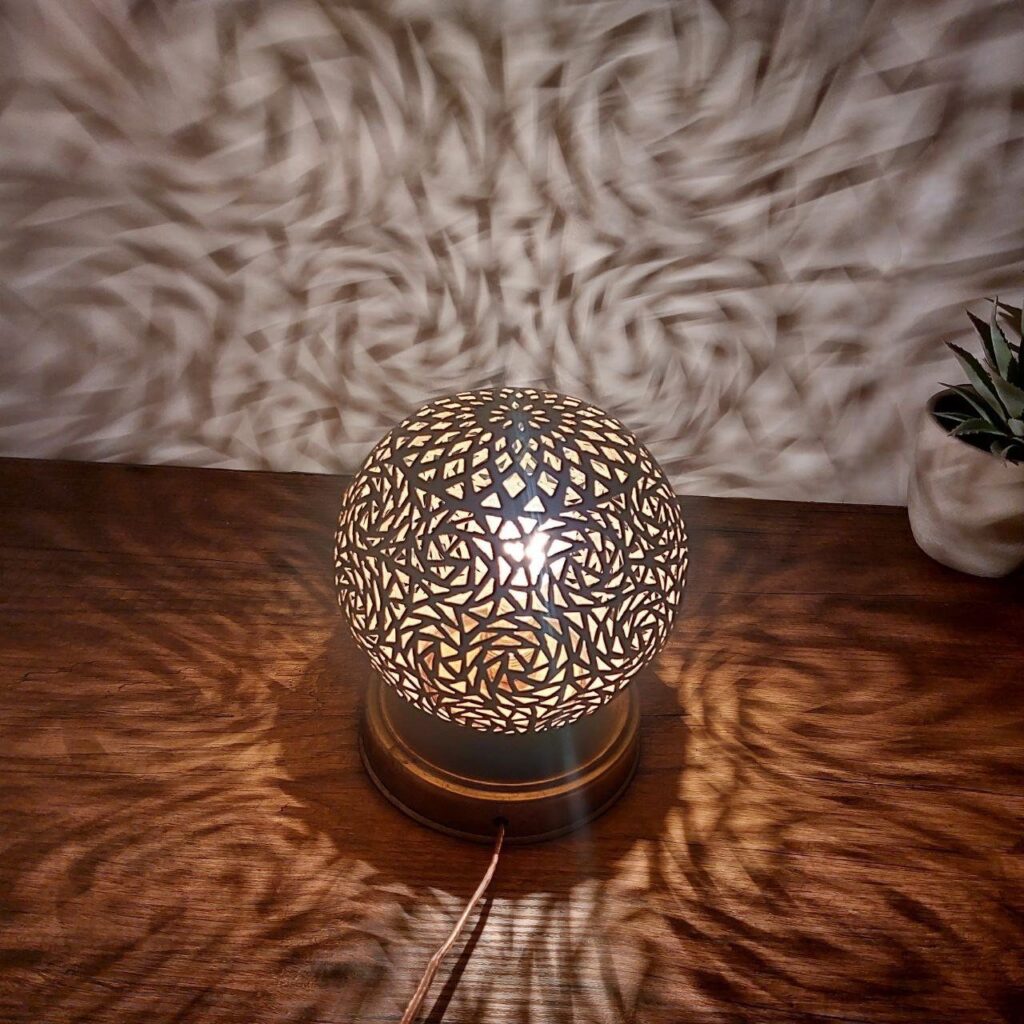
A Moroccan brass lamp can be beautiful before it is switched on. We see the brass, shape, engraving, piercing, proportions, and craftsmanship. When the light is switched on, patterns emerge, shadows travel across walls and ceilings, the brass changes character, and the room changes. The life of the object. The life of the light. Neither is complete without the other.
Light and Shadow Are Part of the Design
Piercing is not simply decoration. It is one of the mechanisms through which the lamp communicates with its surroundings. When the lamp is off, the viewer sees the physical pattern. When it is on, the pattern becomes light, and the wall or ceiling becomes part of the artwork. The object becomes light. The light becomes shadow. The shadow becomes part of the architecture.
Brass Has a Life of Its Own
We choose brass and copper because they possess character. Brass has warmth, colour, and a beautiful relationship with light. With time, oxidation can create new tones and a patina that gives the piece another form of beauty. The piece changes, but it does not necessarily become less beautiful. A brass piece does not simply grow old. It develops a history.
Nature Is a Designer
Many ideas can begin anywhere: an old Moroccan design, architecture, an existing lamp, an unexpected object, or nature. One example began with the Campanula flower. The shape was seen in a nursery and remained in memory. Later it became a drawing, was adjusted, and transformed through piercing into a pendant light. The process was not simply copying the flower. It was translating an observation from nature into another material and another language.
From Existing Models to New Creation
At BrassNoor, we preserve known models, modify existing models, reinterpret old forms, and create completely new designs. A completely new design requires another level of thinking. It may require experimentation, fail, or create technical problems that have never existed before. That difficulty is part of creation.
Copying and Creating Are Not the Same
When an established model is reproduced, the path is already known. Its proportions and construction have already been solved. When a completely new design begins, the path does not yet exist. The artisan must create the path while walking it. That requires imagination, technical knowledge, experimentation, and all the senses. Even when we work with an old model, we can modify, reinterpret, and adapt it. The important thing is that the roots remain visible.
Design Must Have Roots
Innovation does not mean forgetting where we come from. A new design should have roots: Moroccan geometry, vegetal forms, architecture, traditional objects, family memories, nature, light, or workshop knowledge. Innovation without roots becomes imitation of someone else’s language. Innovation with roots becomes evolution.
When the Mind and Hand Enter the Same Rhythm
When reproducing a familiar model, the hand can eventually work almost automatically. The mind knows the process and the body remembers. When creating a new design, the mind, eyes, hands, and senses become fully involved. The artisan observes, thinks, tests, corrects, imagines, changes, and tries again. Creation becomes a conversation between the mind, the senses, and the material.
The Quiet Place Inside the Workshop
There is a moment that is difficult to explain to someone who has never experienced it. You sit before a blank sheet of brass. The tools are ready. The material is waiting. Something changes inside you. It can feel like going to the sea alone: sitting before the ocean, listening to the waves, becoming quiet. The workshop can create the same feeling. The brass is in front of you, the radio may be playing quietly, the hands begin to work, and the mind enters another state — almost like a dream, almost like hypnosis. For a while, there is only you, the material, the idea, and the work.
Every Piece Carries Its Maker
A handmade object is not completely separate from the person who created it. Something remains: time, attention, decisions, the character of the hand, experience, mistakes, corrections, and imagination. This is why a handmade piece can continue speaking long after its maker has gone. The object becomes a continuation of the person who made it.
A Piece Can Outlive Its Maker
We want our work to last not only physically, but culturally and emotionally. A BrassNoor piece should ideally live longer than the moment in which it was made. Ten years. Thirty years. Perhaps a hundred. It may change colour, acquire patina, move from one home to another, and pass from a parent to a child. Eventually, someone may look at it and wonder who made it. Somewhere in that object, a small part of the maker will still be alive.
The Philosophy of BrassNoor
This is what we believe: Craftsmanship gives dignity. The Maâlem carries knowledge. The hand creates character. The mind creates possibilities. The eye recognizes beauty. Light creates emotion. Shadow extends the artwork. Brass carries time. Nature inspires. Heritage gives roots. Innovation gives life.
A lamp can be craftsmanship, art, architecture, light, memory, culture and eventually, heritage. That is the philosophy behind BrassNoor. The Art of Moroccan Brass Lighting.
← Previous: Our Values | The BrassNoor Bible | Next: The Language of Moroccan Ornament →